
Thanksgiving is the hardest test an NYC apartment kitchen faces all year. One oven, a turkey, four sides, a pie, eight guests and a counter that disappears under serving dishes by mid-afternoon. If your kitchen struggles that day, it is telling you exactly what to fix. Good kitchen design for entertaining in NYC starts with those pressure points, not with finishes.
Below is how we approach entertaining-focused kitchens in Manhattan and Brooklyn apartments, where every inch has to work and building rules shape what is possible.
Start With What Went Wrong the Last Time You Hosted
Before any design meeting, write down what actually happened the last time you hosted: where people stood, where dirty dishes piled up, what you had to cook a day early because the oven was busy, and where guests ended up crowding. Those notes are more useful than any inspiration photo. Most problems fall into four groups: prep space, cooking capacity, cleanup and flow.
Prep Space: The Most Common Bottleneck
In most apartment kitchens, the real shortage is clear, continuous counter space. A few principles:
- Protect one long run of counter between the sink and the cooktop. That is where most prep happens.
- Add landing space next to the refrigerator and the oven so hot pans and grocery bags have somewhere to go.
- Consider an island or peninsula only if the room allows comfortable walkways. Kitchen planning guidelines from the National Kitchen & Bath Association call for wider work aisles when more than one person cooks — about 48 inches instead of 42. A cramped island creates more problems than it solves.
- Move small appliances off the counter into an appliance garage or a pantry cabinet with its own outlets.
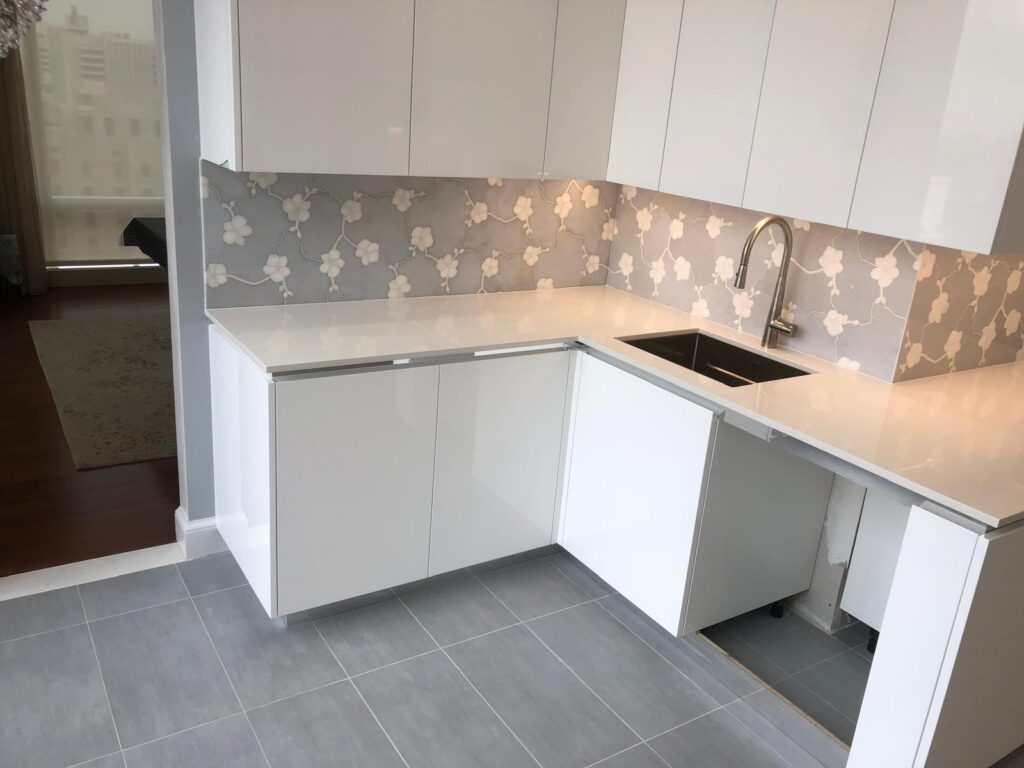
In a galley kitchen, the answer is often extending the counter along an adjoining wall, or replacing an underused run of upper cabinets with a tall pantry so the counters can stay clear. Our guide to choosing the right layout for an NYC apartment kitchen covers galley, L-shaped and open plans in detail.
Cooking Capacity: Ovens, Burners and Ventilation
A single standard oven is the classic Thanksgiving limit. Options that fit apartment kitchens:
- A second wall oven or a combination steam and convection oven stacked in a tall cabinet. A speed oven or steam oven can replace the microwave and frees the main oven for the bird.
- A warming drawer to hold finished dishes at serving temperature.
- An induction cooktop: fast, easy to clean and, in buildings where gas work is complicated, often simpler to approve. Your board and building engineer have the final say on any change to gas lines or electrical capacity.
Ventilation matters more when you cook for a crowd. Many NYC co-ops and condos do not allow new exterior ducting, so a high-quality recirculating hood is common. Read your building’s alteration agreement early; it often decides the hood before the designer does.
Cleanup: Where Hosting Kitchens Usually Fail
The meal takes two hours. Cleanup can feel like four. Design for it:
- A larger single-bowl sink that fits a roasting pan, or a workstation sink with built-in accessories.
- A second dishwasher or dishwasher drawers if you entertain often. Panel-ready models blend into the cabinetry.
- A pull-out trash and recycling center next to the sink, sized for a full dinner party.
- A prep sink on the island, so one person can rinse vegetables while another loads the dishwasher.
Flow: Keep Guests Close but Out of the Work Zone
In an open kitchen, guests drift toward the cook. That is the point of an open plan, but they need somewhere useful to land. A counter-height overhang on the far side of an island, or a built-in bench at the end of a peninsula, gives people a place to sit and talk without standing in front of the oven. Put the beverage station — a beverage refrigerator, a glassware drawer and perhaps a bar sink — at the edge of the kitchen so guests can serve themselves without crossing the cooking zone.
In a closed pre-war kitchen, opening a wall to the dining room is a popular move, but it is a structural and board-approval question first. Our pre-war apartment renovation page explains what to expect.
Storage for the Things You Use Twice a Year
Roasting pans, platters, serving bowls, extra glassware and the good china often live in a closet across the apartment. Plan for them: a tall pull-out pantry, deep drawers with peg dividers for platters, and a cabinet above the refrigerator for seasonal pieces. Custom millwork lets you size every compartment to the pieces you actually own.
Finishes That Survive a Dinner Party
Hosting is hard on surfaces. Quartzite and quartz generally handle hot pans, wine and citrus better than most marbles, though honed marble remains a favorite for clients who welcome a patina. Durable cabinet finishes, integrated hardware and good under-cabinet lighting matter more on a crowded night than on a magazine page. If natural stone is part of your plan, our stone fabrication and installation team can walk you through the options.
When to Start If You Want It Ready for Next Thanksgiving
A high-end kitchen in an NYC apartment is rarely just a construction job. Design, board review of the alteration package, permits where required, and lead times for custom cabinetry, stone and imported appliances often take longer than the build itself. If you want a new kitchen in place for next year’s holidays, the best time to start planning is this winter, while this year’s hosting lessons are fresh. Our kitchen renovation planning guide lays out each step.
Plan Your Entertaining Kitchen With Gurri Remodel
Gurri Remodel designs and builds high-end kitchen remodels across all five NYC boroughs and handles the co-op and condo board process from start to finish. If this Thanksgiving showed you what your kitchen needs, contact us or call 718-490-1643 to start the conversation.